

Metal Strip Aluminium
Transformer manufacturers often specify metal strip aluminium because conductor performance directly affects winding resistance, temperature rise, and energy loss. The primary purchasing concern is electrical conductivity: a strip may look uniform and meet nominal dimensions, yet create inconsistent resistance if alloy chemistry, temper, or test conditions are not controlled.
This article focuses on aluminium strip used in transformer windings, where high-purity grades and verifiable conductivity data matter more than general-purpose forming properties. The International Energy Agency's 2023 report Electricity Grids and Secure Energy Transitions estimates that more than 80 million km of grids worldwide need to be added or refurbished by 2040. This continuing grid investment keeps transformer material specifications under closer scrutiny.
Select the Alloy by Conductivity Requirement
For transformer applications, 1000-series aluminium is commonly selected because its aluminium content is higher than that of manganese- or magnesium-alloyed grades. Under EN 573-3, 1050 contains at least 99.50% aluminium, while 1070 contains at least 99.70% aluminium. Higher purity generally supports higher electrical conductivity, but the purchase specification should still require a mill test certificate rather than relying on grade name alone.
The International Annealed Copper Standard, or IACS, expresses conductivity relative to annealed copper at 20°C. Aluminium electrical conductor material is often discussed near 61% IACS, but actual results depend on composition, temper, and the measurement method. ASTM B193 covers resistance and conductance testing of electrical conductor materials. Ask the mill to report the tested conductivity value, temperature basis, and test method on the certificate.
| Material option | Typical use | Conductivity purchasing focus | Practical note |
|---|---|---|---|
| 1050 aluminium strip | General transformer windings and electrical parts | Confirm %IACS or resistivity on the certificate | Suitable where a documented high-purity grade is required |
| 1070 aluminium strip | Windings requiring higher purity | Verify chemistry and conductivity test result | Often specified where resistance consistency is tightly controlled |
| 3003 aluminium strip | Formed industrial components | Not normally selected for maximum conductivity | Manganese improves strength but reduces conductivity versus 1000 series |
For applications requiring a defined high-purity option, 1070 Aluminum Flat Strip can be evaluated against the winding drawing, conductivity target, and insulation system. Where the design accepts 1050 composition, 1050 Aluminium Metal Strip should be ordered with an agreed certificate format and measurable acceptance criteria.
A useful resistance check can be calculated before production. At 20°C:
R = ρL / A
Where R is resistance, ρ is resistivity, L is conductor length, and A is cross-sectional area. For a rectangular strip, cross-sectional area equals width multiplied by thickness. This calculation helps engineering and purchasing teams compare the effect of a small thickness change against the winding resistance budget.
Specify Dimensions, Temper, and Edge Condition
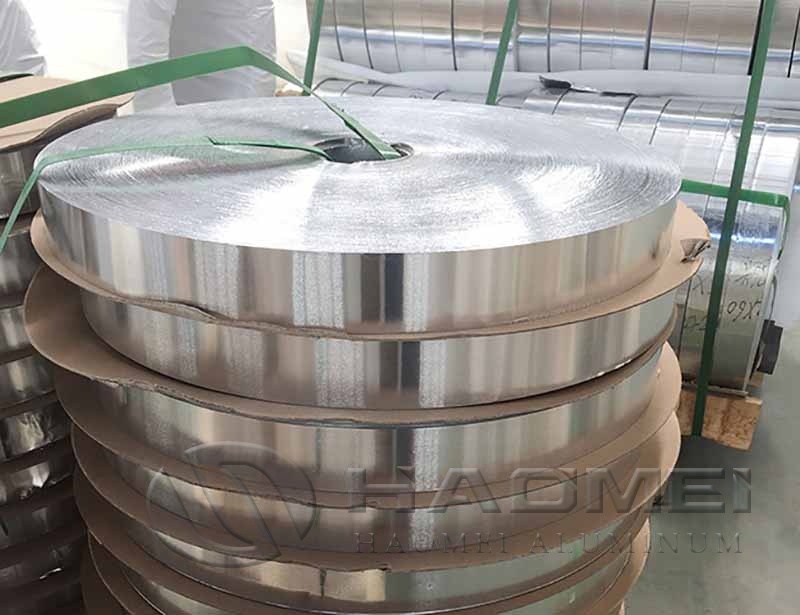
Conductivity alone does not prevent winding problems. Narrow strip must also feed evenly through slitting, insulation, and winding equipment. The order should state the exact dimensions and allowable variation, rather than only providing a nominal width and thickness.
Use this order-entry checklist for transformer conductor strip:
State alloy and applicable composition standard, such as EN 573-3.
State temper, for example O temper when high formability is needed for winding.
Give thickness and width tolerances separately.
Define inside diameter, outside diameter, maximum coil mass, and winding direction.
Specify edge condition: slit edge, deburred edge, or another agreed requirement.
State whether joints are permitted in a coil and define the marking method.
Require conductivity or resistivity results at 20°C on each mill test certificate.
Define surface acceptance limits for oil, dents, scratches, and embedded particles.
EN 485-2 provides mechanical-property requirements for wrought aluminium and aluminium alloy sheet, strip, and plate. It is useful when a contract requires minimum tensile strength and elongation by temper. However, mechanical-property compliance does not automatically verify electrical performance. Include both document sets when the strip will carry current.
| Control item | Why it affects transformer winding | Recommended acceptance evidence |
|---|---|---|
| Conductivity at 20°C | Influences DC resistance and heat generation | Mill test certificate with value and method |
| Thickness variation | Changes cross-sectional area and resistance | Coil inspection report or agreed sampling data |
| Width and camber | Affects alignment during winding | Dimensional inspection report |
| Burr height and edge damage | Can damage enamel or paper insulation | Visual standard and retained sample |
| Coil telescoping | Can interrupt automated payoff | Packing photos and coil handling requirement |
Inspect Documentation Before the Material Reaches Production
A certificate should be reviewed against the purchase order before shipment release. Check that the heat or cast number on the certificate matches the coil identification. Confirm that chemistry, temper, dimensions, and conductivity are listed for the supplied material rather than copied from a generic catalogue range.
When comparing quotations, avoid comparing only price per kilogram. A lower-priced coil may have a different thickness tolerance, wider conductivity range, unapproved joints, or packaging unsuitable for horizontal payoff. These differences can increase scrap, insulation damage, and winding downtime.
For incoming inspection, measure thickness at multiple positions across the width and at the head, middle, and tail of the coil. Inspect both edges under adequate lighting, then retain a sample linked to the coil number. If conductivity verification is performed internally, ensure the instrument and method are appropriate for aluminium conductor material and that the reported temperature is corrected to 20°C.
A complete technical request should contain the alloy, temper, dimensions, conductivity requirement, edge condition, coil geometry, inspection documents, packing method, and delivery condition. This structure gives suppliers measurable requirements and gives transformer plants a clear basis for acceptance.
Original source: https://www.aluminumstrip24.com/news/metal-strip-aluminium.html
Tags: metal strip aluminium, transformer winding aluminium strip,
Previous: Aluminium Strip for Cables Armoring
Next: Aluminum Strip